
The Headstand That Taught Me
When I Stopped Performing and Started Practicing Living
This reflection is about what falling, my breath, and yoga philosophy taught me about being human.
“Yoga is the journey of the self, through the self, to the self.”
— The Bhagavad Gita
At the end of the Bhagavad Gita, it becomes clear that the teachings of scripture are meant to be applied, not idolized. They aren’t the destination but the doorway… an invitation to reflect deeply and then act in alignment with our inner guidance.
This resonates deeply with me.
Yoga was never meant to make life more difficult. It was meant to help us live more freely, more compassionately, and more authentically. The Gita’s closing words echo this truth: “Thus, I have taught you the wisdom that is more secret than all secrets. Ponder over it deeply, and then do as you wish.” — Bhagavad Gita 18:63
These words highlight the importance of personal reflection and choice. The teachings exist to guide and inspire… not to dictate.
And that, to me, is where yoga becomes a truly personal journey.
When Philosophy Became Personal
The teachings of yoga had always spoken to me, but there was a moment when they moved from theory into lived experience. A moment when the philosophy stopped being something I understood in my mind and became something I felt in my body.
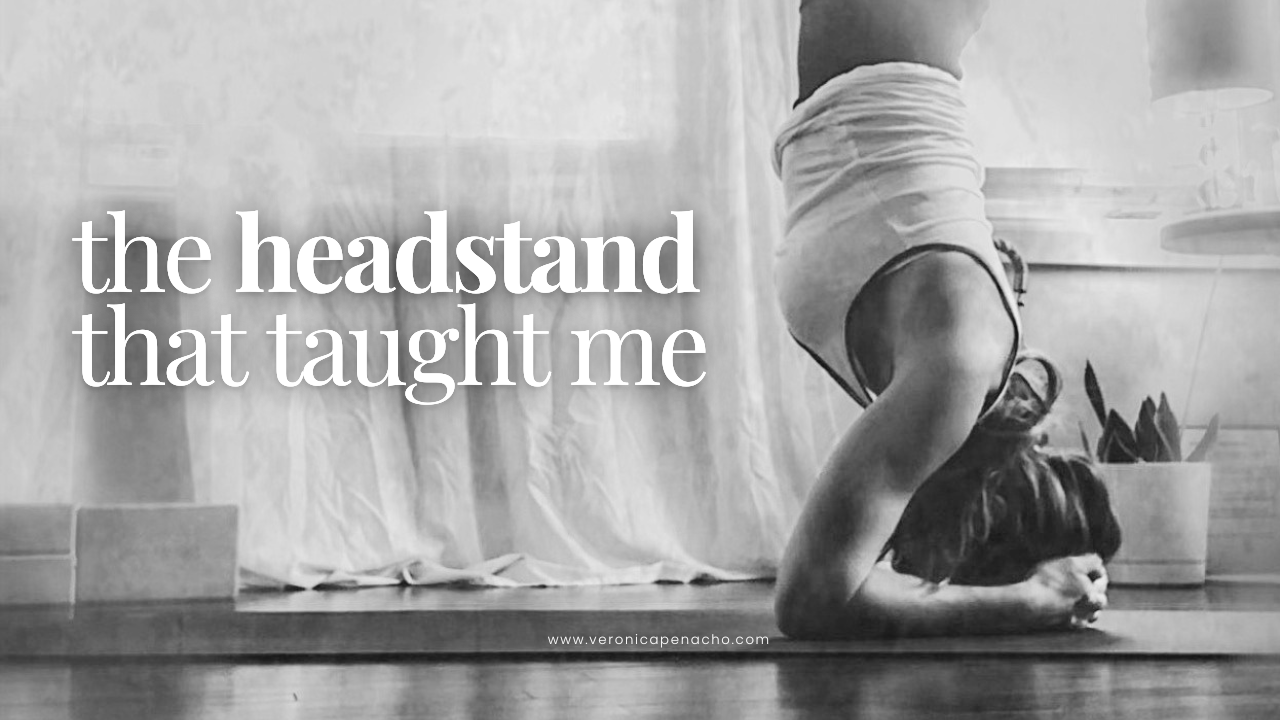
For me, that moment arrived in the most unexpected place: the headstand.
For a long time, I struggled with mastering the headstand. Every attempt was met with frustration and self-criticism. I wasn’t just trying to balance my body. I was trying to live up to an inner expectation of getting it “right.”
My perfectionism and impatience surfaced the moment I tipped over.
During this struggle, the Gita’s message of selfless action and detachment from outcomes echoed in my mind. I realized I had been approaching the pose with the wrong intention. I wasn’t practicing. I was performing. I wasn’t exploring. I was demanding.
So, I shifted my approach.
I began meeting each attempt with presence, curiosity, and compassion. Every wobble became information. Every fall became part of the story. Every breath became an anchor. Gradually, the pose changed.
And so did I.
Letting go of my attachment to the “perfect” headstand (and all the layers it represented) opened the door to deeper self-awareness and ease. The practice became lighter, more joyful, and more aligned with the person I was becoming.
The Breath
Breath and inspiration are deeply connected… both literally and symbolically. By observing our breath, we gain profound insight into our inner world. When your breath is tight in your chest, it often points to emotional or physical suppression. Noticing this is the first step in understanding where you may feel stuck, and what is calling for attention.
Yoga offered me the space for this awareness.
I began to observe my thoughts and emotions during practice and realized that the frustration I felt had little to do with the headstand. It was a reflection of old wounds, unresolved emotions, and perfectionistic patterns that were still living in my body.
The pose was just a mirror.
Through consciously working with my breath, I started to see how often I held tension, expectations, and stress… not just on the mat, but in my life. Holding my breath in the headstand mirrored how tightly I held onto control in challenging situations.
This awareness gave me permission to soften, to feel, and to release.
Beyond the Physical
While many turn to yoga for physical strength, its true power lies in its ability to integrate the physical, emotional, mental, and spiritual aspects of who we are. Yoga invites us to explore our inner landscape as deeply as we explore the poses. It asks us to observe our breath, tend to our emotions, and understand how those emotions manifest in the body.
Yoga taught me that life does not need to be rigid. Strength and flexibility (physically, psychologically, and spiritually) develop when we allow ourselves to breathe, explore, and release expectations.
Looking Back
Revisiting this nearly five-year-old journal entry, I realized something surprising: I no longer practice the headstand, and not for the reasons I once feared.
At the time, the experience was profound. From falling to trusting my body to support itself upside down, it pushed me into unfamiliar and uncomfortable territory. I remember being terrified. My mind flashed images of breaking my neck.
The discomfort wasn’t subtle… it was primal.
And that was the moment I uncovered a deeper truth: I had been living inside a lie I didn’t know I was telling myself.
Whenever I tried something new and didn’t get it right immediately, I would tell myself I didn’t want it or that it wasn’t for me. I made excuses to avoid the discomfort of being a beginner. Beneath that avoidance was a belief etched into my conditioning:
I am only worthy when I get things right.
I am only valuable when I am perfect.
That belief came from years of being validated only when I excelled, and met with surprise, disappointment, or judgment when I didn’t. Mistakes weren’t neutral; they were shocking. They signaled that I had fallen out of the “role” others expected me to play. So, I learned to perform. I learned to always know, always succeed, always excel.
What I didn’t realize was that I began policing myself with the same harshness.
The headstand brought all of this to the surface. My frustration wasn’t about balance… it was about self-worth. My irritability, my anger, my exhaustion, my overwhelm… were bout my self-worth. All of it was unfolding beneath the surface, and I had been calling it “being hard on myself” as if that was normal or necessary.
The pose became a mirror.
And it wasn’t just the Bhagavad Gita that guided me. Teachings from the Yoga Sutras and other philosophies echoed the same theme: compassion, patience, dedication, and permission to be human.
Why I Don’t Use the Headstand Anymore
I no longer practice the headstand regularly. Not because I’m avoiding something emotionally or find it challenging (though it is), but because I simply don’t need it anymore. I attempted it. I taught it. I experienced it. I mastered it.
And then I moved on.
I didn’t master it because I finally got into the pose, but because I finally understood the lesson it revealed. The pose served its purpose. It brought important parts of me back online: Discernment. Compassion. Patience. Trust. The ability to honour discomfort without abandoning myself.
Today, the reason I don’t practice headstand is simple and physical…
I don’t enjoy the sensation of blood rushing to my head, and my neck doesn’t feel supported in a way that nurtures connection. There are countless other poses through which I can meditate, breathe, explore, and ground myself without overriding my body’s intelligence. Avoidance isn’t the reason. Resistance isn’t the reason.
This is about choosing practices that connect, and most importantly… support.
I’ve learned that discomfort is not always a spiritual lesson. Sometimes it’s simply the body saying, This doesn’t feel good for me right now.
And that, too, is wisdom.
What this Journey Has Given Me
Looking back at that earlier version of myself, I feel nothing but gratitude, humility, and love.
She was brave enough to open up. She was willing to be vulnerable. She believed in herself even when she didn’t have all the answers. She was true to herself in a way that laid the foundation for everything that followed. Through yoga, through philosophy, breath, and embodied practice, I uncovered layers of myself I didn’t know were waiting to be revealed and ultimately, healed.
The headstand was never just a pose. It was an initiation. A mirror. A revelation. A teacher.
And it served me… until it didn’t.
That, too, is yoga: listening, discerning, honouring, evolving, and returning… again, and again.
Breath as a Bridge
This journey is also why I’m so passionate about how I serve. The breath was the first place I learned to listen, truly listen.. to myself. It showed me where I was holding, where I was collapsing, where I was afraid, and where I was ready to open.
The practices I now teach were born from lived experience. From falling out of poses, from meeting my own perfectionism, from learning to soften instead of force, from discovering that breath reveals what the mind tries to hide.
Everything I offer is rooted in this simple truth: When we slow down enough to listen, the breath becomes a guide, a healer, and a doorway back to who we’ve always been.
